
Who actually delivers AI — and why it isn’t a matter of a diploma or “super prompts”
The internet today is flooded with courses promising one thing: learn to write “super prompts” and AI will start working miracles. Alongside runs the belief that an AI deployment will simply be delivered by whoever has the best diploma or the most technical knowledge. These things help — but on their own they don’t decide the outcome. This text is about what really separates the people and teams who deliver working AI from those whose projects end up in the failure statistics.
It is not a list of talents you have to be born with. It is a set of habits and approach — and that is good news, because an approach can be learned.
One caveat up front, so we understand each other. We are not talking about an ordinary chat — where you ask the model a question, get an answer, and that’s it. Such a single conversation needs no special predispositions, and that’s fine. We are talking about something else and more serious: deploying AI to real work — when a model, or a whole team of agents, has to carry out something in a company, in a process, with consequences, day after day. That is a completely different league than “type — reply — bye-bye”, and this text is about it.
What helps — but isn’t enough on its own
There are things that are valuable and useful but, by themselves, are not enough to deliver AI. It is worth naming them, because it is easy to mistake something helpful for something decisive.
A diploma and deep technical knowledge. A specialist education can be useful, but — note — it decides nothing on its own, and narrowly understood it can even get in the way. There are people with enormous technical knowledge who make serious design mistakes because they look at their own slice rather than the whole. Research on failed deployments points to this directly: one common cause of failure is chasing the latest technology instead of the real goal — a specialist in love with the tool loses sight of what they were deploying it for in the first place. Depth in one field doesn’t help when the problem sits at the junction of five.
What from technical knowledge really helps is not a title, but something more modest: understanding the nature of this tool — enough to know where AI is reliable and where it starts making things up. And here an important caveat: AI is not an ordinary, passive tool like a hammer. It carries enormous knowledge and assembles it on the fly, in a flash — it can add something of its own, connect things, go beyond what you literally asked for. That is exactly why the limits have to be watched: not because the tool will break, but because this “tool” thinks for itself and sometimes throws in something you didn’t want. Understanding this doesn’t require being an engineer — common sense and curiosity about how the machine actually works are enough. The rest of the expertise tends to be ballast rather than an advantage.
The “super prompt”. A well-phrased instruction helps in a single conversation with the model. But a deployment is not one conversation — it is a process with a goal, limits, verification and consequences. No clever prompt will fix a project without a clear goal, nor replace oversight of what the model does in production. A trick works on stage; the lever is the approach.
What really sets apart those who deliver
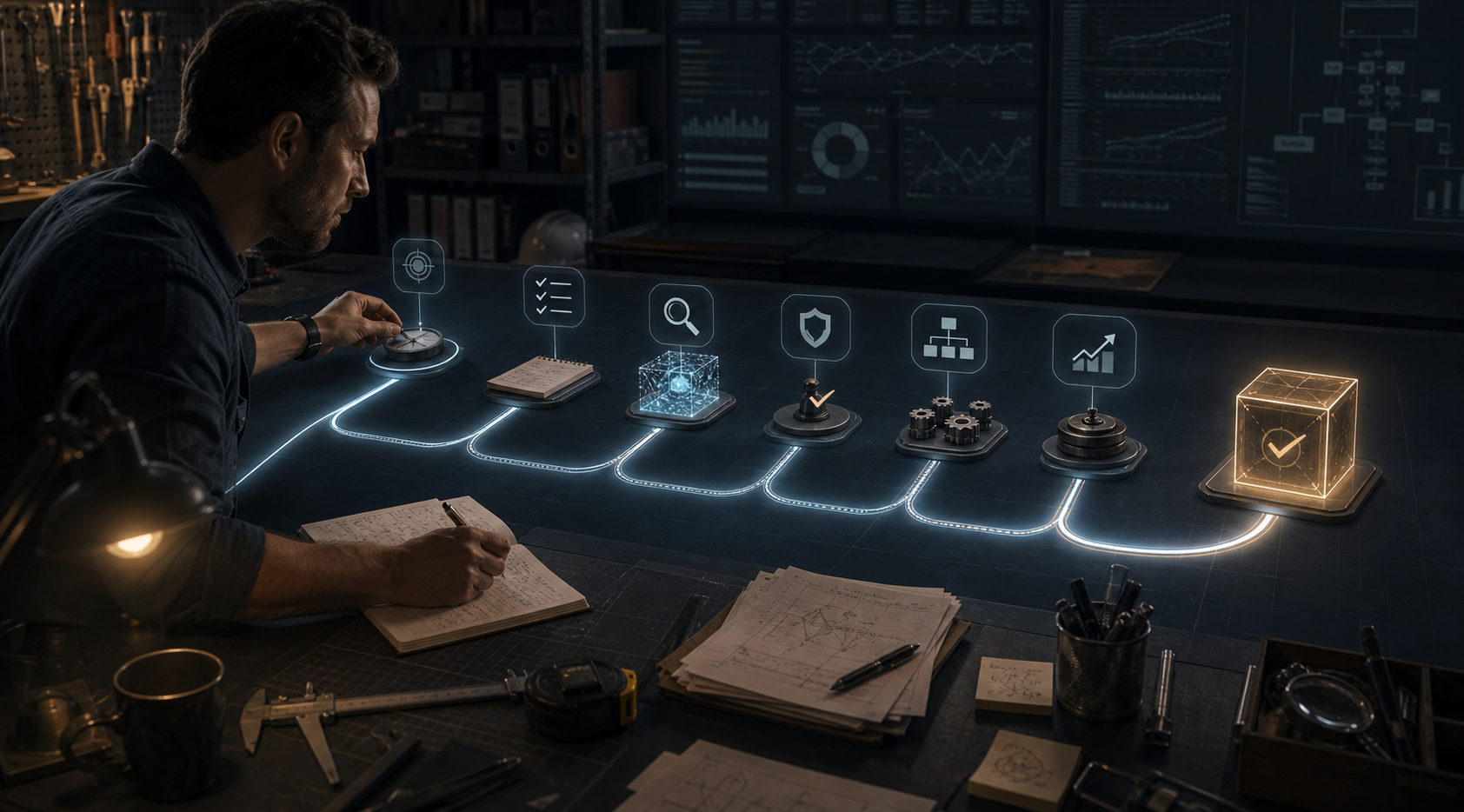
The most interesting thing is that the predispositions for AI don’t have to be guessed. It’s enough to invert the documented reasons why deployments fail. Since projects lose on vague goals, lack of oversight, chasing trends and fading commitment — the people who deliver do exactly the opposite:
They start from a clear goal. Before launching anything, they can say what concretely is supposed to happen and how they will know it succeeded. The absence of such a definition is the number-one cause of failure — so its presence is the number-one advantage.
They watch the model’s limits and look for where it will break. They know the model works well only within a certain range, and they don’t let it out of that range without oversight. Instead of admiring what already works, they instinctively look for the spot where the system will fail — asking “what could go wrong here?” before it does. That is the opposite of the wishful thinking that drives most failed pilots.
They are resistant to fashion. They don’t launch a project because “you have to have AI”, nor buy a tool because everyone is talking about it. They tell a real need from noise — a rare and valuable skill in a time when there is more noise than substance.
They think in tasks, not roles. Instead of telling AI to “be an expert in everything”, they give it narrow, concrete tasks with a clear start and end. They know that the wider they stretch the scope, the easier the system gets lost.
They demand proof — and can’t be talked into it. They don’t accept “it probably works”. They want a checkable result, ideally verified by someone other than the author. “Done” without proof they treat as not done. And here lies a paradox: a nice technical spiel lulls precisely the person who knows the jargon — it sounds familiar, so they nod along. Someone focused on the concrete asks briefly “show me it works”, and a pretty bluff has nothing to latch onto. Sometimes a person without a technical background, but attuned to the concrete, spots the weak point faster than a specialist enchanted by their own jargon.
They slow down as the stakes rise. Counterintuitively, on the most serious tasks a good AI person slows down rather than speeds up. They make a backup, a plan and a check before touching anything irreversible. Recklessness in production isn’t courage, it’s a cost.
What sits underneath — traits of character
These six habits don’t come from nowhere. Beneath them lie a few traits of character that turn out to matter more than any technical knowledge:
Seeing the whole. This is perhaps the most important of these traits — and the rarest. A good tradesperson walks onto the site and sees the entire job at once: how the pieces will connect, which way it will run, where it will meet, what fits with what. They don’t build piece by piece hoping it will come together at the end — they have the picture of the whole in their head from the start and only then fit the details into it. With AI it works the same way: such a person enters a problem and sees the whole system — where data flows from and to, where something might break, how one element will affect another — instead of picking at an isolated fragment. This ability to quickly connect facts and assemble them into a picture beats narrow, deep specialization everywhere the problem sits at the junction of many things at once — and with AI it almost always does.
Working on many threads at once — and fast. A serious deployment is rarely a conversation with one agent. More often you run several or a dozen at once, everything happening in parallel and in seconds, not at a weekly meeting. Whoever delivers holds many threads simultaneously without losing any, and decides on the fly — based on what they have, without waiting for a complete set of data that will never come anyway. They don’t analyze endlessly: they settle it, move on, correct along the way if needed. That is closer to the work of a conductor or a foreman on a big site than a one-on-one conversation.
Persistence. When something doesn’t work, the person who delivers doesn’t make a drama of it and doesn’t give up — they try again, calmly, until it works. An AI deployment is rarely a single shot; more often a series of fixes. The winner is not the one who starts with fireworks, but the one who doesn’t drop out after the third failed attempt.
Humility about one’s own knowledge. They know what they don’t know — and don’t play the expert where they aren’t one. But they also know their own field well and trust what they see in it. It is a rare combination: enough confidence to act, and enough humility to ask and check rather than guess.
Openness instead of a ready-made thesis. They don’t start from the conviction “I know how this will turn out”, but give themselves and the team room to check. They don’t bend reality to fit a pre-formed answer — they let the data show how things really are.
Notice that these are traits you find in a good craftsperson, a good manager of a household, a practitioner from any trade — not in an “AI person” in the narrow sense. And that is the crux: what decides success is the way of working, not a stock of technical terms. These habits are not the privilege of the sharpest minds — anyone who takes the matter seriously can build them.
It’s an approach, not a talent
You don’t need higher education, knowledge of foreign languages or an AI-expert title for this. We know from practice cases of people with no formal technical background who deliver working AI solutions better than many a specialist — because they have exactly this approach: they ask about the goal, watch the limits, demand proof. Discipline and common sense beat a formal title wherever what counts is delivering, not making an impression.
This also explains why “super prompt” courses sell better than they should: they promise a shortcut where there is none. The real lever — a clear goal, oversight, verification, resistance to fashion — is less flashy and harder to package into a single trick. But it is what separates a project that pays off from one that ends up in the statistics.
Summary
The predisposition to deliver AI is not the diploma itself and not a collection of clever prompts. Technical knowledge helps, but the real difference is made by the approach: clear goals, watching the model’s limits, resistance to fashion, thinking in tasks, demanding proof, and slowing down where the stakes are highest. All these traits are the mirror image of the documented reasons why AI deployments fail — and none is a talent you have to be born with. Anyone can have them, regardless of education or job title.
So if you are wondering who in your organization should lead an AI deployment, don’t look for the most brilliant person or the best prompter. Look for the one who asks the hard question “and how will we know it worked?” — and won’t move until they have the answer.
MafiaAI — a team of people and AI agents building tools, websites and solutions. More: t8.pl